


























 0
0
In the previous article, we showed how the Tosh Group combines productivity and strategic vision to excel in U.S. pork production. Now, we go inside the farm to present the technologies adopted and how efficiency translates into practice.
The farm we visited weans 34 piglets per sow per year, above the company average (32.5), even with reduced staff and less nighttime supervision. With a 10% mortality rate in the farrowing room and 15.3 born alive per litter, this example demonstrates that it is possible to maintain high performance with smaller teams: a common challenge in Latin America as well.

Facilities and environment
Due to the extreme weather conditions in the U.S., all the farms are climate-controlled. In winter, the challenge is maintaining the ideal temperature, using gas turbines integrated into the ventilation system for heating. In summer, they use ventilation, misting, and evaporative cooling.
In farrowing, the system differs from the Latin American standard: air inlets in the roof and side extractors promote air renewal and cooling through an insulated roof, which is effective in winter, but has limitations on the hottest days.
Management from farrowing to weaning
Surgical castration is performed at five days of age. In cases of unilateral cryptorchidism, tail docking is avoided to facilitate identification of these animals at weaning. If the testicle has not descended, the slaughterhouse may reject the animal or apply penalties.
Weaning is done at 21 days, a common practice in the U.S. to increase room turnover and optimize production, unlike Brazil (average of 24 days) and Europe (minimum of 28 days by legal requirement).
The rooms are cleaned by a dedicated worker according to the weaning schedule. The gestating sows are brought in approximately four days before farrowing.
Nutrition and feeding management
Due to labor shortages, feed management is highly simplified and automated: one operator is responsible for 300 sows, requiring maximum efficiency. Feed arrives in bulk by truck, is stored in silos, and is distributed via an auger line and a chain disc system.
Distinctive features:
- Potato powder is used to stimulate feed intake in piglets;
- Leftover feed from the breeding herd is reused during the piglets' starter phase, promoting adaptation and reducing waste;
- Diets are less concentrated, aiming for a lower cost per kilogram of pork produced rather than the best possible feed conversion ratio. This results in simpler, lower-cost feeds with fewer additives during the nursery phase;
- Feed is 100% pelleted, a practice still uncommon on U.S. swine farms.
Health program
In the U.S., PRRS is endemic and represents one of the major health challenges. Outbreaks can reduce weaned piglets by 4 to 6 per sow per year, significantly impacting productivity. Therefore, substantial investment is made in vaccination and disease control, and the replacement rate can reach 60% due to high pathogen pressure.
The five main diseases they currently face are PRRS, PED (porcine epidemic diarrhea), porcine circovirus type 2 (PCV2), influenza, and senecavirus. None of these were reported in the U.S. in the 1980s. Increased farm size and animal density have made disease control more complex and increased the risk of disease spread, requiring increasingly rigorous protocols.
In cases of Actinobacillus pleuropneumoniae (APP) infection, the vaccination protocol is adjusted completely. Because it is an unpredictable and highly aggressive bacterium, its presence is one of the criteria used to decide whether to depopulate a farm, especially when it is associated with other diseases such as PPRS or PED.
Preventive vaccination against salmonellosis is also done.
Biosecurity
The farm we visited is isolated, fenced, and has a clearly defined biosecurity area. Visitors are required to have a 48-hour downtime without contact with other farms, register prior, and have authorization via an access password—a measure that reinforces entry control at the facility (Figure 1 - left). Upon exiting the vehicle, visitors wear disposable shoe covers until they reach the farm entrance. At that point, they must remove their shoes and enter the clean area wearing only socks (Figure 1 - right).
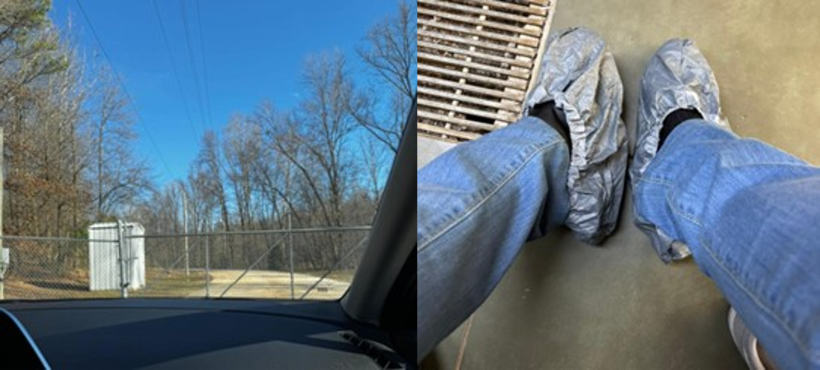
Figure 1. Farm access gates with a strictly password-controlled entry system (left). Disposable shoe covers for farm access (right).
All workers leave their shoes in the dirty area before entering the farm (Figure 2 - left). The bathroom is individual, extremely clean, and well-maintained (Figure 2 - right), with a ratio of one bathroom for every four workers of the same sex (Figure 3 - left).
Each worker has an individually identified uniform and towel (Figure 3 - right). Boots are for internal use only and do not leave the farm. To access areas such as the office, everyone wears only socks, demonstrating the farm's strict hygiene protocols.
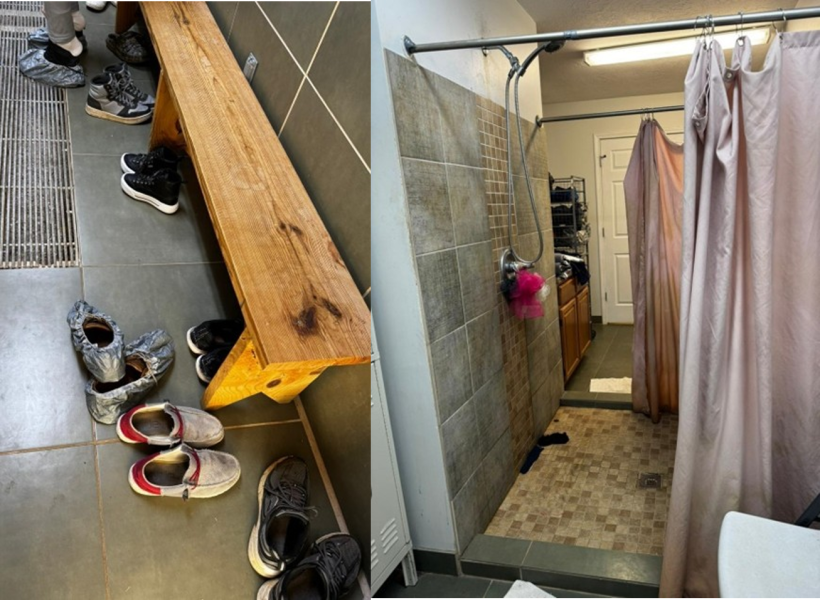
Figure 2. Staff shoes are left in the dirty area (left). Individual toilets (right).
Biosecurity is an essential pillar for animal health and production efficiency. The rigor of the protocols adopted by the farm reinforces its commitment to disease prevention, maintaining productivity, and ensuring the sanitary quality of production.
Conclusion
The visit to the Tosh Group farm revealed a highly professional production system that combines technology, rigorous biosecurity, and efficient use of labor. Even in the face of complex health challenges, the farm maintains high production levels and stands out as a model for modern swine production, especially for Latin American countries seeking to evolve their systems with a focus on sustainability, animal welfare, and profitability.
